Necropolis Club
The Reincarnationist PapersThe Necropolis Club is an Egyptian-themed bar in downtown Los Angeles, housed in a former movie theater. It is at once a recurring refuge for Evan Michaels and a practical meeting place for criminal plans: amid its music, crowds, and familiar bartender, he meets a client seeking a killing and later uses the club’s backstage route to leave for an arson. Its rooms lend these actions a surface of nightlife and routine, even as the club’s private corners make them possible.
Setting and atmosphere
The club occupies a repurposed theater whose transformation is deliberately spare. The seats were removed, the floor leveled, bars installed along the front and back walls, and a stage built before the large silver movie screen. Black-and-white films play there without sound behind the bands, leaving the old cinema’s screen as a silent backdrop to the new entertainment. The venue’s setting therefore retains the outline of its former use while giving it a different, crowded life.
Its Egyptian theme is carried through the decor rather than through any elaborate reconstruction. The walls are black, stripped clean, and covered with enormous white bas-relief portraits of strange-looking Egyptian gods. Along both walls, thick frosted-glass bar tops glow from blue-white neon beneath them, making the drinks seem almost as if they must be iridescent blue. These details turn a converted movie house into a visually conspicuous club, a place whose theatrical surfaces contrast with the practical, hurried business Evan conducts inside it.
From quiet haunt to crowded club
For roughly a year, the Necropolis had been Evan’s bar of choice. Its popularity changes after a feature in the LA Weekly: what had been quiet begins drawing newcomers from as far away as Simi Valley and Chino. A line forms outside, and the club’s growing reputation alters the experience of arrival. Evan is fortunate to be let past the queue by the bouncer on one visit, while on another he nods to the doorman and enters at the head of a short line.
The crowd changes, but the room itself does not. The old theater, silent films, glowing bars, and monumental reliefs persist as the club becomes fashionable. That continuity gives the place a stable identity in the changing city around it: the audience may be newly arrived, but the interior remains the one Evan knows. Even on a muggy Los Angeles night, when he has been shut in his room for days and the downtown air hangs thick with smells, going out to the club feels like a welcome return to the outside world.
Meetings and familiar faces
The club is where Evan meets Martin, who has arranged to see him there. Evan arrives at 10:45, earlier than the midnight meeting time, and goes to the back bar, where he finds the last empty seat. When Martin arrives, dazed and gasping at the sight of him, Evan leads him back to the bar. Their meeting quickly turns to business: Evan asks how Martin wants the killing done, and Martin says it must look like an accident. The club’s ordinary bar setting thus becomes the place where a murder is commissioned, with the surrounding social bustle providing a mundane cover for a dangerous exchange.
Henry, working behind the bar, is another constant in the club’s life. He greets Evan by name, and Evan smiles when he recognizes him. Their familiarity does not make Henry an unquestioning accomplice: when Evan indicates that Martin is with him, Henry turns away skeptically. In a later episode, however, Henry helps Evan with access to the club’s storage room and a route outside. Their connection makes the bar more than a public venue; it is also a place where an established personal acquaintance can open a discreet way through the building.
A route from the club to the night’s work
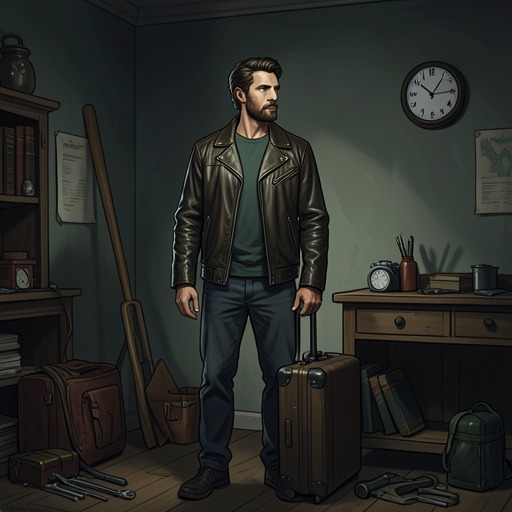
The Necropolis also figures in Evan’s preparations for arson. Before the night’s work, he lays out a black leather jacket, black leather gloves, black high-top sneakers, and a green army-surplus rucksack. He has not worn the jacket and gloves since his previous job four months earlier. The club is closed when he first arrives; he searches nearby alleys for intact liquor bottles, finds four, and buys a large bottle of cheap vodka and two packs of generic cigarettes. He places the full bottle with the empties in the rucksack and the cigarettes in his jacket pocket.
When he returns, a short line has formed. He enters after nodding to the doorman and joins Henry, who is listening to music with him. The time suddenly becomes urgent: Evan realizes it is already 10:45 and asks Henry for his gear. Henry leads him behind a black curtain into the storage room, then directs him through a door he will leave propped open until closing. This backstage passage links the public club to Evan’s covert departure. The venue’s ordinary divisions—bar, curtain, storage room, exit—become part of the practical sequence that carries him from preparation to action.
Narrative significance
The Necropolis is defined by this double use. Its fixed theatrical interior shelters a changing public crowd, while its familiar staff and back rooms give Evan access to spaces beyond the dance floor and bar. The contrast is not simply between respectable and illicit worlds: both occupy the same building, and the movement between them is made through routine gestures, from nodding to the doorman to following Henry behind a curtain. The club’s importance lies in that conjunction of atmosphere and access. It is a place Evan knows well enough to feel at home, and one whose familiar architecture can be put to dangerous use.